Your search for Rosemary returned 16 items.
Displaying items 1 thru 15
Rosemary
Shrouded in ancient legends and the smoke from modern barbecue grills, rosemary is a pungent, resinous, evergreen shrub native to the rocky Mediterranean cliffs. It has been savored as both culinary and medicinal elixir, making palatable roasted goat meat and restoring sexual vitality. Surely one of the essential kitchen herbs, and, in its hardier forms, a handsome landscape subject. Fresh or dried, leaves are used in meat dishes and stews, with roasted potatoes, and other vegetables--in fact, it goes with almost everything from appetizers to desserts.
Plants are variously hardy; most varieties will withstand temperatures from 15 to 20°F, a few may survive as low as -5°F (see sidebar). A minimum 4 hours of direct sun is required for optimal growth. Heavy soils should be lightened with plenty of humus to make it friable; nutrient needs are moderate. As little as 12 inches of rain annually is enough for rosemary to survive, but an inch a week will make it thrive. The pH range is wide, from 4.9 to 8.2. Depending on the variety, plants should be spaced on 3 to 8 foot centers.
Rosemary.
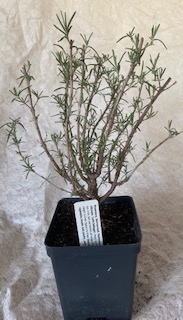
Rosmarinus officinalis 'Miss Jessopp's Upright'. Delicate, dark green leaves are pointed and thin with a pleasant, fresh aroma. growth is open and upright on fairly thin stems. The plant was introduced by E.A. Bowles in England and named after Euphemia Jessopp. Light blue flowers. Tender.Rosemary.
Rosmarinus officinalis 'Mrs. Howard's Creeping'. The large, wide, medium-green leaves on thick trailing stems, and its taller stature separate this variety from the well-known 'Prostratus'. Light blue blossoms are produced several times during the year. The aroma is more traditional than other creeping varieties. Hardy to about 20°F. and may grow 1-2 feet tall and infinitely wide.Rosemary.
Rosmarinus officinalis 'Tuscan Blue'. Strongly upright with thick stems, this rosemary can reach heights of 7 feet or more where it can grow unencumbered by winter winds. Its columnar shape is noble, while its uniquely wide and stubby leaves shine with a mild, fresh scent. It is hardy to at least 15°F and some enthusiasts insist it is hardy for them in our climate, although it never has been for us.Rosemary, Collingwood Ingram.
Rosmarinus officinalis 'Collingwood Ingram'. This tender variety has thick, deep green, glossy leaves that contrast dramatically with its thick, light colored stems. It makes a bushy upright plant when pruned regularly. Flowers are deep violet and very striking for a rosemary. Sometimes found in the trade as 'Rex #4', 'Majorca', and 'Wood'.Rosemary, Dutch Mill.
Rosmarinus officinalis 'Dutch Mill'. This variety, a selection made by Barbara Remington of Forest Grove, Oregon, appears to have hardiness to about -5°F. It is a well-shaped plant, classically rotund, that glistens with light-blue flowers each spring. Its fragrant leaves are medium-green and lightly textured. Mature plant height is about 4 feet.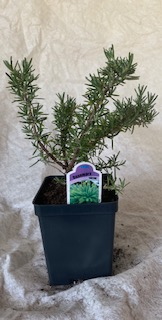
Rosemary, Foxtail.
Rosmarinus officinalis 'Foxtail'.Rosemary, Golden Rain.
Rosmarinus officinalis 'Joyce DeBaggio'. Our own introduction, now found in nurseries around the U.S., this variety began its multi-colored life as an atypical branch on a common rosemary. The medium-sized, pointed leaves dazzle the eye with their serpentine green centers on a golden background. Overall, the plant radiates a golden aura. It has bushy, compact growth and requires little pruning other than that necessitated by use. Leaves are more refined than many other varieties, but they contain a sharply pungent, resinous aroma. Scattered dark blue flowers are found on mature plants that reach 5 feet tall. Hardy to about 20°F.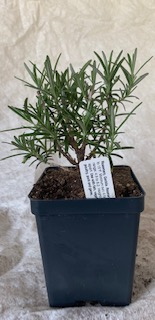
Rosemary, Gorizia.
Rosmarinus officinalis 'Gorizia'. The long, broad leaves of this unique rosemary extend from thick, rigidly upright stems blushed with a reddish brown. Its leaves are fat and long, double the size of more ordinary varieties. Light blue flowers, often in the summer, cluster along tall, unpruned stems. While the aroma of the leaves is not overpowering, it is gentle, sweet, and a bit gingery. This plant, unique in its coarse vigor, is hardy to about 15°F. Mature plants may grow to 5 feet tall and as broad.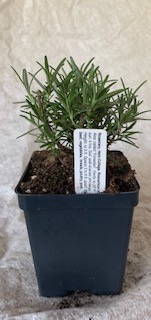
Rosemary, Herb Cottage.
Rosmarinus officinalis 'Herb Cottage'. This is a delightfully upright variety without the rigidity or swagger of 'Tuscan Blue'. It sparkles with tightly spaced foliage that produces a good clear scent. This cultivar is sometimes sold as 'Foresteri'.Rosemary, Hill Hardy.
Rosmarinus officinalis 'Madalene Hill'. Winter hardy below zero in most areas, this variety has superior form and color. Its stiff, dark green foliage is held thickly on semi-upright stems and is more compact than 'Arp'. The foliage aroma is soft but assertive. Plants bloom light blue in late fall and in spring when stems have not been pruned and winter is kind. Height to five feet and as wide. This and 'Arp' appear to be the hardiest varieties.Rosemary, Mrs. Reed's Dark Blue.
Rosmarinus officinalis 'Mrs. Reed's Dark Blue'. Its bushy growth habit and dark green foliage make this variety one of the most attractive of all rosemary plants. Dark blue flowers are carried on year-old wood. The dark green leaves are a kitchen favorite. This fast growing tender perennial is hardy to about 15°F and grows 5 to 6 feet tall and as wide.