Your search for Lavender returned 18 items.
Displaying items 1 thru 15
Lavandula angustifolia
'Lavance Deep Purple'. Description not available at this timeLavender.
Lavandula 'Superblue'. Description not available at this timelavender
Early season bloomers are forms of Lavandula angustifolia and are typical of the winter hardy lavenders grown in England. They are winter hardy in our climate and burst into flower in late May or early June, but they do not usually flower later in the year. These stalwart, decorative plants offer a wide variety of flower color, shape and size. Although the varieties we offer were all introduced in the 20th century, their genetic lines go back hundreds of years.
Lavender.
Lavandula angustifolia 'Blue Cushion'. Perennial. Hardy to below 0°F. Dark blue flowers in early summer.Lavender.
Lavandula angustifolia 'Lady'. This 1994 All America Selection winner is a Burpee introduction, a seed-grown lavender about 12 inches high with blue flowers. Foliage is richly aromatic.Last Seed Source: www.ivygarth.com
Lavender.
Lavandula angustifolia 'Sweet Romance'.Lavender, Pink Flowered.
Lavandula angustifolia 'Jean Davis'. Also known as 'Rosea'. Hardy to below 0°F. Compact plant with tight, dense growth habit. Pink flowers appear in late May/early June. Plant reaches a height of 18 inches with 6 inch flower spikes. Use in potpourri, tea, jam and desserts.Lavandin
These mid-season blooming lavender varieties are unique, dramatic, highly ornamental hybrids with beautifully rounded shapes, long, elegant stems, and substantial flower heads. To distinguish them from other lavender, the French call them 'Lavandin' (Lavandula xintermedia). They begin blooming in mid-June just as the English lavender are losing their punch. Unlike Lavandula angustifolia cultivars, these are sterile hybrids, crosses of Lavandula angustifolia and Lavandula latifolia. This mixing of genes has created dazzling lavandins with silver-gray pointed leaves that are as vibrant in winter as in summer. Their long flower stems and bright flowers make them natural for crafting lavender fans, wands and swags. These lavandin varieties are only slightly less winter hardy because of their mixed genetic backgrounds. Lavandins generally are more tolerant of our humid summers than lavender (Lavandula angustifolia).
Lavandula
'Phenomenal'.Lavandin.
Lavandula x intermedia 'Dutch'. This may be the most widely cultivated lavender in the U.S., England, and the Netherlands. The French lavender growers also favor this one. A beautiful globular shape, large very gray leaves. Flowers are dark violet and carried on stems about 20 inches long. Vegetative plant height: 16 inches. Bloom sometimes unreliable. Introduced sometime before 1923.Lavandin.
Lavandula x intermedia 'Fred Boutin'. Unique, large plants reach 20 inches in height and 30 inches across. Hardy below 0°F. Violet flowers used in potpourri.Lavandin.
Lavandula x intermedia 'Provence'. This French hybrid produces long, elegantly pointed gray-green leaves that create a large globular plant. Although the name seems to indicate otherwise, and many catalogs claim it to be, this is not one of the cultivars used in the commercial oil trade. Vegetative plants are 18 to 20 inches tall and may reach 3 feet in diameter. Long 18-inch flower spikes carry clusters of dark aster violet flowers. Space on 3 foot centers.Lavandin, Fat Spike.
Lavandula x intermedia 'Grosso'. If I could grow one lavender only, 'Grosso' would be my first choice. For form, color, and year round good looks, this hybrid can't be beat. It was discovered in the Vaucluse District of France in 1972 and named after the famous lavender grower Pierre Grosso. It has become an important commercial cultivar because of its disease resistance. We call it Fat Spike because of its huge, dark violet flower heads, 3 inches long and filled with 10 circles of flowers atop stately 14 to 20-inch stems. The plants form gorgeous gray mounds of foliage that are 20 inches high (nearly 4 feet when in bloom) and 3 feet in diameter. Plant on 30 to 48- inch centers.Lavandin, White-flowered.
Lavandula x intermedia 'Alba'. Large mounded plant makes a dazzling landscape shrub and is set off with large gray foliage. Typical vigor of this hybrid variety. Tall spikes topped by white inflorescences. Not available until May. Supplies are limited.Tender Lavenders
Tender lavenders are in an aromatic and esthetic category of their own. Their complex beauty springs from strongly scented and finely modeled leaves, as well as unusually shaped inflorescences in which colored bracts play an important decorative role. They make excellent subjects for container gardens where their aroma and summer flowers will create comment and ornamental value. Bring their containers inside and their blooms and foliage will brighten winter's dreary habits. These plants are hardy to about 25°F, and may occasionally overwinter in a warm, protected location.
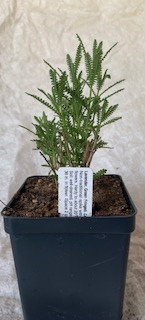
Lavender, Fernleaf.
Lavandula multifida. One of the most unusual lavenders. At first glance this does not appear to be a lavender at all. Finely cut green leaves highlight this sprawling 24 inch high plant with multiple bright blue flowers. The aroma is decidedly unlavender-like, almost like turpentine.Lavender, Goodwin Creek Grey.
Lavandula x ginginsii 'Goodwin Creek Grey'. This recent hybrid (L. dentata x L. lanata) has delightful silver-green, fuzzy, serrated leaves, a sweet odor, and dark blue flowers. Plants can reach 24 inches high and as round.